Cart is empty
Achieving quality excellence requires more than just meeting compliance standards. It demands a commitment to continuous improvement.
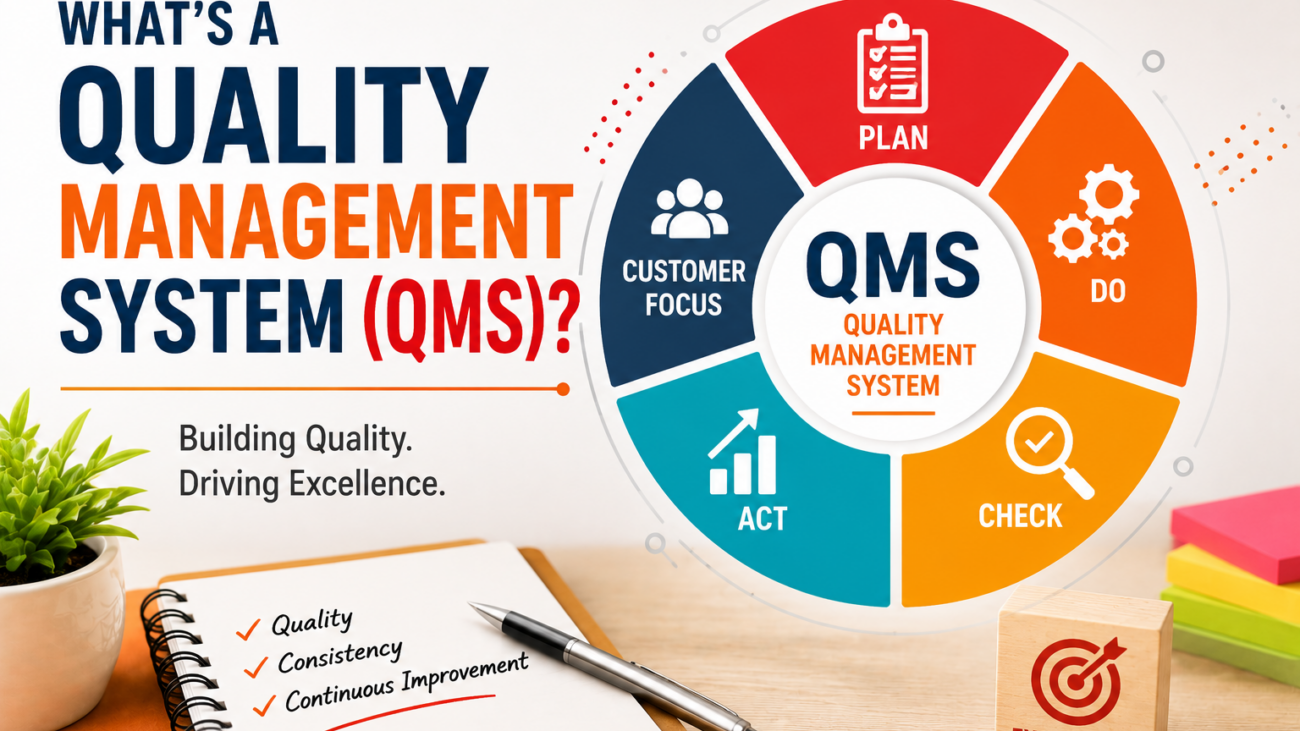
As the foundation of ISO 9001, Quality Management System (QMS), the PDCA model is the framework that helps organizations to systematically plan, implement, monitor, and enhance their processes. It transforms quality management from a one-time initiative into a continuous journey of improvement and learning.
This post will help you understand more about the PDCA Cycle, it’s four important phases, the benefits, limitations, and practical applications.
What is the PDCA Cycle?
The PDCA Cycle, also known as the Deming Cycle or Shewhart Cycle, is a four-stage iterative process designed to facilitate ongoing improvement within organizations. Developed by quality pioneer W. Edwards Deming, this model provides a structured approach to problem-solving, innovation, and process optimization.
The acronym PDCA stands for Plan, Do, Check, and Act. These are four interrelated steps that, when repeated continuously, create a culture of quality and performance excellence.
Each step feeds into the next, ensuring that improvement is systematic and sustainable rather than reactive or just one-off.
The Four Stages of the PDCA Cycle: A Detailed Explanation
The four stages of the PDCA Cycle each serve a distinct yet complementary purpose.
Together, they provide a powerful mechanism for building, maintaining, and continuously improving a Quality Management System (QMS).
1. Plan
The first stage, Plan, focuses on preparation and strategic planning.
Here, you define what needs improvement by identifying problems, analyzing root causes, and setting clear and measurable objectives. This phase involves gathering data, determining customer needs, and aligning quality objectives with business goals.
In the context of ISO 9001 QMS implementation, planning includes:
-
- Establishing the quality policy
-
- Defining processes
-
- Assessing risks and opportunities
-
- Allocating the resources required for success
A well-thought-out plan sets the foundation for consistent performance and effective decision-making.
2. Do
The next stage, Do, is where the plan is put into action.
It involves implementing the designed processes, executing improvement activities, and training teams to carry out their tasks effectively.
During this stage, data is collected to track how well the plan is being followed and to assess its impact. Often, organizations begin with small-scale pilot tests to validate changes before applying them broadly.
For example, a manufacturer might trial a new inspection process in one production line before rolling it out company-wide. The Do phase transforms strategic intent into tangible action, turning ideas into results.
3. Check
Following implementation, the Check stage emphasizes measurement and evaluation.
This is where you assess performance by comparing actual results against planned objectives.
The ‘Check’ phase involves:
-
- Analyzing data
-
- Reviewing KPIs
-
- Conducting internal audits or management reviews to determine whether the desired outcomes were achieved.
If discrepancies arise, further investigation (e.g root cause analysis) is conducted to identify underlying issues. This step is vital for promoting evidence-based decision-making, a key principle of ISO 9001:2015.
It ensures that conclusions are drawn from data evidence rather than assumptions.
4. Act
Finally, the Act stage focuses on standardizing successful improvements and taking corrective or preventive actions when results fall short.
If the changes implemented in the “Do” phase prove effective, they are documented, communicated, and embedded into standard operating procedures.
However, if expected goals are not met, the organization identifies what went wrong and implements actions to address the gap. The lessons learned are then fed back into the next “Plan” phase, allowing the cycle to start again.
This continuous loop fosters ongoing improvement, a hallmark of every successful QMS.
When to Use the PDCA Cycle
The PDCA model is highly versatile and applicable across all types of industries and organizational functions.
It is most effective when:
-
- Implementing or improving a Quality Management System (QMS)
-
- Introducing changes to enhance product/service quality
-
- Optimizing production or operational processes
-
- Managing non-conformities and corrective actions
-
- Conducting internal audits and performance evaluations
-
- Supporting compliance with ISO 9001:2015 or other management system standards
Whenever your organization aims to plan effectively, execute reliably, monitor performance, and take informed action, the PDCA Cycle serves as an ideal framework.
Benefits of the PDCA Cycle in QMS
The benefits of applying the PDCA Cycle within a Quality Management System are extensive and well-documented. Here are some of its proven benefits:
-
- Promotes Continuous Improvement – Ensures that processes are regularly reviewed, measured, and refined.
-
- Encourages Evidence-Based Decisions – The “Check” phase reinforces data-driven analysis rather than assumptions.
-
- Aligns with ISO 9001 Requirements – PDCA is embedded in the structure of ISO standards, ensuring system-wide consistency.
-
- Improves Efficiency and Productivity – Helps identify waste, streamline operations, and enhance process flow.
-
- Engages Employees at All Levels – Fosters ownership, collaboration, and a shared commitment to quality.
-
- Boosts Customer Satisfaction – Better processes result in consistent quality and fewer complaints.
By adopting the PDCA Cycle, organizations can build resilient systems that deliver measurable results and continuous improvement.
Limitations of the PDCA Cycle
While the PDCA Cycle is highly effective, it’s not without challenges. Here are some challenges organizations might phase when applying this change managemen model.
-
- It can be time-consuming when dealing with complex or large-scale systems.
-
- The process requires discipline and a culture of accountability to be effective
-
- Without management support, the cycle may stall at the “Check” phase, with improvements never fully implemented.
-
- In fast-changing environments, lengthy PDCA iterations may lag behind evolving needs.
However, when integrated with modern data analytics or agile management approaches, PDCA remains one of the most reliable tools for sustainable improvement.
PDCA Cycle Examples
Example 1: Customer Complaint Reduction
A company identifies an increase in customer complaints about delayed deliveries. During the Plan phase, they analyze the causes and set an objective to reduce delays by 25%. In the Do phase, they implement a new logistics tracking system. The Check phase measures the system’s effectiveness over three months, and in the Act phase, the new process is standardized across all regions.
Example 2: Food Safety Process Improvement
A food manufacturer notices recurring packaging defects. They Plan by identifying root causes and setting corrective objectives. In the Do stage, they test a new sealing method. The Check stage compares defect rates before and after implementation, and the Act phase applies the improved method plant-wide while updating SOPs and training.
Example 3: Internal Audit Effectiveness
A company planning its annual ISO 9001 internal audit uses PDCA to enhance efficiency. It Plans by revising its audit schedule, Does by training auditors, Checks audit results for trends, and Acts by improving audit templates and follow-up systems. This continuous loop ensures better compliance and higher audit quality over time.
The PDCA Cycle and ISO 9001 Quality Management
The ISO 9001:2015 standard is fundamentally based on the PDCA Cycle, since each clause corresponds to one of the PDCA stages:
-
- Plan: Clauses 4–6 (Context, Leadership, and Planning) focus on establishing the framework, understanding needs, and setting quality objectives.
-
- Do: Clauses 7–8 (Support and Operation) address resource management and process execution.
-
- Check: Clause 9 (Performance Evaluation) covers monitoring, measurement, internal audits, and analysis.
-
- Act: Clause 10 (Improvement) ensures organizations take corrective actions and continually enhance the QMS.
This alignment ensures that the PDCA Cycle is not merely a tool but the structural backbone of every ISO 9001-compliant management system.
Frequently Asked Questions (FAQs)
1. What is the PDCA Cycle?
The PDCA Cycle (Plan–Do–Check–Act) is a continuous improvement model used in quality management to test ideas, implement changes, evaluate results, and standardize successful improvements. It helps organizations refine processes in a systematic, repeatable way.
2. What are the four stages of PDCA?
The four stages of PDCA are:
-
- Plan: Identify a problem or goal and develop a strategy to address it.
-
- Do: Implement the plan on a small scale to test the change.
-
- Check: Evaluate the results and compare them with expected outcomes.
-
- Act: Standardize successful changes or take corrective actions and restart the cycle.
3. Is PDCA Lean or Six Sigma?
PDCA is used in both Lean and Six Sigma, but it originated independently through W. Edwards Deming’s quality improvement work. Lean uses PDCA to eliminate waste and improve flow, while Six Sigma applies it to reduce variation and improve process quality.
4. Is PDCA a Kaizen?
PDCA is a core tool within Kaizen, but not the same thing. Kaizen is a broader philosophy of continuous improvement, while PDCA is the structured method used to implement and sustain those improvement.
Conclusion
The PDCA cycle is far more than a theoretical model—it’s the engine behind every successful QMS. By structuring your planning, execution, monitoring and improvement phases, you embed continuous improvement into the DNA of your organisation.
If you’re working to implement or improve a QMS, whether in the food & beverage industry or across any sector, take time to apply the PDCA cycle consciously to each process. The return is not just compliance! It’s better performance, higher efficiency, improved customer satisfaction and a culture of excellence.
If you’d like help in mapping your company’s processes to PDCA, establishing KPIs and driving continuous improvement, check out our QMS Implementation services and QMS auditing services in Kenya and get in touch with us whenever you’re ready!